
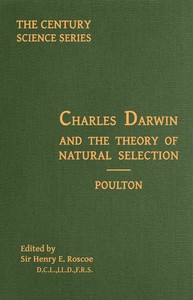
Charles Darwin and the Theory of Natural Selection by Sir Edward Bagnall Poulton
Forget the white-bearded sage on the textbook page. Sir Edward Poulton’s book pulls Charles Darwin off that pedestal and puts him right in the middle of a storm. Poulton wasn’t some distant historian; he was a respected biologist who moved in the same circles as Darwin’s closest allies and fiercest opponents. This gives his account a unique, almost gossipy feel—it’s science history from someone who knew the players.
The Story
The book isn't a straight timeline of Darwin's life. Instead, it focuses on the explosive aftermath of 1859. Poulton walks us through the immediate firestorm caused by 'On the Origin of Species.' We see Darwin, a gentle and anxious man, steeling himself against attacks from powerful religious figures and even fellow scientists. The story follows how the theory of natural selection was tested, debated, and slowly pieced together with new evidence—from butterfly wings to beetle shells—often by Darwin's own defenders, like the bulldog Thomas Huxley. It's a tale of evidence versus dogma, told by a man who saw the ripples of that conflict shape his own career.
Why You Should Read It
What grabbed me was the humanity. Poulton shows Darwin’s struggle with public scorn and private illness, making his ultimate triumph feel hard-won. You get a real sense of how science advances: not in a clean, logical line, but through stubbornness, friendship, and sometimes lucky discoveries. Poulton’s own passion for the subject is contagious. He isn't neutral; he’s a firm believer, and his writing makes you feel why this idea was so thrilling and terrifying to its first audience. It reminds you that every "established fact" was once a crazy idea someone had to fight for.
Final Verdict
Perfect for history buffs and science lovers who enjoy a good intellectual drama. If you liked 'The Invention of Nature' or are fascinated by how ideas change the world, you’ll love this perspective. It’s a bit denser than a pop-science book, but Poulton’s direct connection to the events makes it worth the effort. You’ll finish it with a whole new appreciation for the messy, argumentative, and deeply human story behind one of our most important scientific theories.
This book is widely considered to be in the public domain. Thank you for supporting open literature.
Donna Williams
1 year agoWithout a doubt, the atmosphere created is totally immersive. Don't hesitate to start reading.
Melissa Nguyen
1 month agoBased on the summary, I decided to read it and the arguments are well-supported by credible references. I couldn't put it down.
Paul Smith
2 years agoIf you enjoy this genre, the storytelling feels authentic and emotionally grounded. I couldn't put it down.
Patricia Jackson
1 year agoI came across this while browsing and the storytelling feels authentic and emotionally grounded. I couldn't put it down.



Andrew Walker
1 year agoBased on the summary, I decided to read it and the narrative structure is incredibly compelling. Don't hesitate to start reading.