1

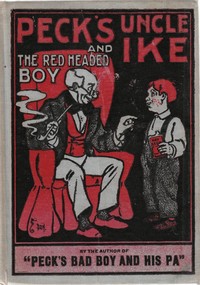
Peck's Uncle Ike and The Red Headed Boy 1899 — Themes and Context
20
4
Project Gutenberg
2008
American wit and humor; Uncles -- Fiction; Boys -- Fiction
Readers of public-domain and historical texts
Project Gutenberg digital edition
en
Edition facts
Words: 54,193
Reading time: 236 min
Text sections: 6
Source:
Project Gutenberg record #25490
George W. Peck's 1899 comic novel pairs a wise uncle with a mischievous red-headed boy in episodic adventures, blending humor, moral lessons, and social commentary through dialogue and practical jokes.
Editorial Edition Score
4.7/5
★★★★★
★★★★★
Calculated from edition completeness, EPUB availability, text structure and catalogue metadata. Not a user rating.
Edition quality
George W. Peck's Peck's Uncle Ike and The Red Headed Boy (1899) pairs a shrewd, pipe-smoking uncle with a mischievous red-headed boy in a series of comic episodes. The dedication to the “Typical American Boy” sets the tone: a boy who “investigates everything in the way of machinery, even if he gets his fingers pinched” and grows into a man “ready for anything, from praying for his country's prosperity to fighting for its honor.” This blend of rough-and-tumble humor and earnest advice runs through the excerpts, where Uncle Ike dispenses wisdom on topics from porous plasters to the departure of John Jacob Astor, while the boy orchestrates pranks like stealing a playmate's clothes and leaving him a flour sack to wear home.
Uncle Ike's Conversational Authority
Uncle Ike's voice dominates the excerpts through long, digressive monologues that mix homespun philosophy with pointed social critique. In one passage, he turns a boy's complaint about a porous plaster into a meditation on wealth and charity, using John Jacob Astor's departure for England as a springboard: “The only way for a rich man to be very happy is to find avenues for getting his congested wealth off his mind.” The boy's response—“Gosh! … if you are not a comfort!”—underscores how Uncle Ike's rambling speeches serve both as comic set pieces and as vehicles for moral instruction. His authority is never questioned; even when he forces the red-headed boy to swap clothes with the victim of a prank, the boy complies without serious protest.
The Red-Headed Boy's Practical Jokes
The red-headed boy's mischief is the engine of the comedy. In Chapter XIV, he gleefully describes stealing a boy's clothes at the swimming hole, leaving him “a paper flour sack to go home in.” The victim marches down the street “as unconcerned as possible,” while the red-headed boy laughs and calls it “just for a joke.” Uncle Ike's response—forcing the prankster to don the flour sack himself and run an errand—turns the joke back on him, a pattern of reciprocal discipline. The boy's energy is relentless: he bursts into rooms “all out of breath, his shirt unbuttoned and his hair wet and dripping,” and his dialogue is peppered with exclamations like “Had more fun than a barrel of monkeys.” These details paint a character who is impulsive, inventive, and ultimately teachable.
Social Commentary Through Humor
Peck weaves topical commentary into the banter. Uncle Ike's remarks on Astor—that he “will run a race there, and get tired of it; and some day, if he lives, he will come back to this country in the steerage”—reflect a skepticism of inherited wealth and expatriate pretensions. The dedication's ideal of the “all-around boy” who can “take up a collection in church, or take up an artery” suggests a democratic, self-reliant masculinity. The flour-sack episode, meanwhile, gently mocks social embarrassment while affirming that even a humiliating punishment can be borne with good humor. These moments, scattered through the excerpts, give the comedy a satirical edge without overwhelming the slapstick.
Readers should approach Peck's Uncle Ike and The Red Headed Boy as a series of loosely connected vignettes rather than a plotted novel. The humor depends on the interplay between Uncle Ike's long-winded wisdom and the boy's impulsive schemes. Pay attention to how Peck uses dialect, exaggerated situations, and sudden reversals—the boy who laughs at a prank may find himself wearing the flour sack. The book rewards those who enjoy period American humor and the tension between mischief and moralizing.
Reader reflection
What did you think of this book?
Answer a few questions and save a private reflection on this device.
Your progress
0
/
10
2
Did this book hold your interest?
3
Would you encourage someone else to read it?
4
How easy was the book to follow?
5
How strong was your personal connection to the text?
6
How clearly were the main ideas presented?
7
What did you appreciate most?
8
Did you gain anything practical from the text?
9
What did this book teach you most?
10