1

Light Freights — Text and Context
12
1
Project Gutenberg
2007
Humorous stories, English; England -- Social life and customs -- Fiction; River life -- Fiction
Readers of public-domain and historical texts
Project Gutenberg digital edition
en
Edition facts
Words: 67,492
Reading time: 294 min
Text sections: 19
Source:
Project Gutenberg record #21928
W. W. Jacobs's 1901 collection of humorous river and dockside tales, narrated largely by a night-watchman, uses dialect and misadventure to explore money, drink, and domestic confusion among working-class men.
Editorial Edition Score
4.8/5
★★★★★
★★★★★
Calculated from edition completeness, EPUB availability, text structure and catalogue metadata. Not a user rating.
Edition quality
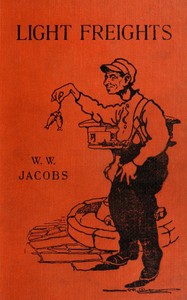
In Light Freights, W. W. Jacobs builds his comic narratives around a recurring night-watchman who spins yarns from a wharf-side soapbox. The opening story, “An Odd Freak,” immediately establishes the collection’s voice: the watchman’s dialect is thick with dropped h’s and colloquial rhythms, and his digressive style—pausing to observe a steamer’s docking—mirrors the unhurried pace of river life. The catalog subjects list “humorous stories, English” and “river life,” and the excerpts bear this out, but the humor is less about gentle whimsy than about sharp-edged schemes, misplaced trust, and the physical comedy of men trying to outwit each other over beer money.
Dialect and the Night-Watchman’s Frame
The collection is unified by a framing device: a night-watchman who recounts anecdotes to an unnamed listener. His speech is rendered phonetically (“’ad,” “’appened,” “’eap”), which gives the prose a performed, oral quality. This is not merely decorative; the dialect signals class and setting, anchoring the stories in the working-class milieu of London’s docks and riverside pubs. The watchman’s asides—such as his observation that “the sharpest man I ever knew never ’ad a ha’penny in ’is pocket”—serve as both comic setup and social commentary. The excerpts show that Jacobs uses the frame to create distance: the watchman finds the events funny, while the characters themselves often see nothing amusing in their predicaments.
Money, Thirst, and Misapplied Kindness
A persistent theme in the excerpts is the pursuit of drink and the absurd economies of pub life. In “An Odd Freak,” a group of firemen, broke after payday, devise schemes to get beer bought for them—including a trick where one man pretends to be about to knock down a policeman. Later, in “The Peacemaker,” the teetotaler Job Brown offers a five-pound reward for help staying sober, only to have his mates “help” by drinking his beer or dropping sawdust in his mug. The humor arises from the gap between intention and outcome: the men claim to be doing Brown a kindness, but their actions provoke violence and resentment. Jacobs treats these episodes with a deadpan irony that undercuts any moralizing.
Domestic Disruption and Mistaken Identity
The excerpts also reveal a recurring pattern of domestic confusion. In the Job Brown story, a drunken man stumbles into what he thinks is his own bedroom, only to find another family—Dick Weed, his wife, and baby—asleep in his bed. The scene relies on mistaken identity and the physical comedy of a man too drunk to recognize his own home. This motif appears elsewhere in the collection: the illustration list includes “False Colours” and “A Question of Habit,” suggesting similar mix-ups. The humor is situational rather than character-driven, and Jacobs often lets the absurdity of the premise carry the scene, with dialogue that escalates from confusion to outrage.
Readers approaching Light Freights should expect a series of self-contained anecdotes rather than a novelistic plot. The stories reward attention to Jacobs’s use of dialect and his skill at building comic tension through misunderstanding. The night-watchman’s frame invites the reader to share his amused, slightly detached perspective, even as the characters blunder into trouble. The collection is best enjoyed in short sittings, letting each tale’s particular scheme or mishap stand on its own.
Reader reflection
How did this book work for you?
Your answers remain private and are stored only in this browser.
Your progress
0
/
10
2
Did this book hold your interest?
3
Is this a title you would suggest to others?
4
How easy was the book to follow?
5
How valuable was this book for your own interests?
6
Did you relate to its people, ideas, or situations?
7
How distinctive were its ideas or approach?
8
Did the book meet your expectations?
9
Which lesson or insight stayed with you?
10