1

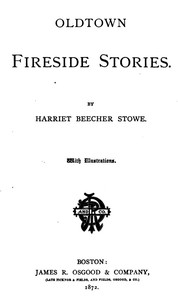
Oldtown Fireside Stories — Text and Context
11
1
Project Gutenberg
2007
New England -- Social life and customs -- Fiction; United States -- Social life and customs -- 19th century -- Fiction; Women -- New England -- Fiction
Readers of public-domain and historical texts
Project Gutenberg digital edition
en
Edition facts
Words: 36,120
Reading time: 158 min
Text sections: 4
Source:
Project Gutenberg record #22320
Harriet Beecher Stowe's 1872 collection of New England folk tales, framed by a fireside narrator, blends ghost stories, local legends, and comic anecdotes with a colloquial, oral storytelling voice that shifts between suspense and humor.
Editorial Edition Score
4.6/5
★★★★★
★★★★★
Calculated from edition completeness, EPUB availability, text structure and catalogue metadata. Not a user rating.
Edition quality
Harriet Beecher Stowe's Oldtown Fireside Stories opens with a framing device that explicitly sets the scene for oral storytelling: a winter evening, a glowing fire, and children begging for tales. The narrator describes a time before magazines and serials, when “chimney-corner story-telling became an art and an accomplishment.” This is not a mere preface; it establishes the collection's narrative voice—a blend of colloquial dialect, folk wisdom, and a deliberate, unhurried pace that mirrors the rise and fall of firelight. The stories themselves, such as “The Ghost in the Mill” and “Captain Kidd's Money,” are told by characters like Sam Lawson, whose speech is rich with regional idioms and digressions. The prose shifts between eerie suspense and comic relief, often within a single tale, as when a ghost story is interrupted by a mundane detail about a pig in a well.
The Framing of Oral Tradition
The opening paragraphs of the collection are crucial for understanding its narrative structure. Stowe does not simply present stories; she creates a context for them. The narrator recalls a time when “the aged told their stories to the young,” and the tales were “told to sympathetic audiences, by the rising and falling light of the solemn embers.” This framing emphasizes the communal, oral nature of the narratives. The voice of the frame narrator is educated and reflective, contrasting with the dialect of the storytellers like Sam Lawson. This juxtaposition highlights the collection's interest in preserving a vanishing mode of storytelling. The pace in the frame is slow, descriptive, and atmospheric, while the embedded tales often accelerate into action or dialogue. For instance, in “The Ghost in the Mill,” the frame's calm exposition gives way to Sam's rapid, colloquial account of a supernatural encounter. The shift in pace is marked by a change in sentence length and vocabulary, from the frame's periodic sentences to Sam's short, breathless phrases.
Dialect and Narrative Voice
Stowe's use of dialect is not merely decorative; it shapes the narrative voice and pace of each story. Sam Lawson's speech, as seen in the excerpt from “Captain Kidd's Money,” is full of contractions, regional pronunciations (“fust,” “nateral,” “critter”), and digressive asides. His sentences often run on, mimicking the rhythm of spoken yarns: “Tom he was one of your rael Maine boys, that's hatched out, so to speak, in water like ducks.” This colloquial voice creates an intimate, conversational tone that draws the reader into the tale. The pace of these sections is meandering, with frequent interruptions for background details or humorous observations. In contrast, the frame narrator's voice is more formal and measured, providing a counterpoint that underscores the shift from literate to oral modes. The stories also vary in pace depending on the teller; for example, the tale of the mysterious lady in mourning in “Captain Kidd's Money” builds suspense through short, clipped sentences (“Where she come from, or what she wanted, or where she was goin' to, we none on us knew”), while comic passages slow down with repetitive, rhythmic descriptions of hens “a craw-crawin', and a histin' up one foot.”
Recurring Motifs and Structural Patterns
Several motifs recur across the stories, contributing to a consistent narrative texture. Ghosts, hidden money, and mysterious strangers appear repeatedly, often with a twist that undercuts the supernatural. In “The Ghost in the Mill,” the ghost is ultimately explained as a natural phenomenon, while in “Captain Kidd's Money,” the treasure hunt ends in anticlimax. This pattern of building suspense then deflating it with a rational or comic resolution is a structural hallmark. The pace mirrors this: tension rises through detailed descriptions of eerie settings (the dark mill, the lonely road) and then abruptly shifts to a casual, almost dismissive explanation. Stowe also uses repetition of phrases and situations, such as the motif of the “soft-hearted” sea captain easily swayed by a woman's tears. These repetitions create a rhythm that feels folkloric, as if the stories have been told many times before. The settings—New England villages, ships, and farmhouses—are rendered with specific, sensory details (the “blue-mixed yarn stocking,” the “solemn embers”) that ground the fantastical elements in a recognizable world.
Readers approaching Oldtown Fireside Stories should attend to the interplay between the frame narrator's voice and the dialect of the storytellers. The collection rewards attention to the shifts in pace and tone, which are as much a part of the narrative as the plots themselves. Stowe's work is best enjoyed as a series of performances, where the telling is as important as the tale. Listen for the pauses, the digressions, and the sudden bursts of action that mimic the rhythms of a winter evening by the fire.
Reader reflection
What did you think of this book?
Answer a few questions and save a private reflection on this device.
Your progress
0
/
10
2
How much did you enjoy the reading experience?
3
Would you pass this book on to a friend?
4
How easy was the book to follow?
5
Would you like to discuss this book with someone?
6
Was the book moving at the right speed?
7
Was the book what you thought it would be?
8
Did this book create an emotional response?
9
What changed or sharpened your thinking?
10