1

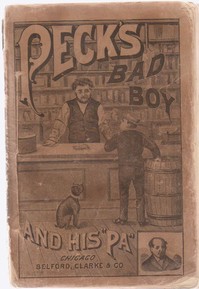
Peck's Bad Boy and His Pa 1883 — Inside the Classic
19
3
Project Gutenberg
2008
American wit and humor; Boys -- Fiction; Practical jokes -- Fiction
Readers of public-domain and historical texts
Project Gutenberg digital edition
en
Edition facts
Words: 55,724
Reading time: 243 min
Text sections: 7
Source:
Project Gutenberg record #25487
George W. Peck's 1883 comic sketches follow a mischievous boy's pranks on his father, mixing slapstick, dialect, and domestic chaos. The catalog subjects 'practical jokes' and 'boys' fit, but the humor relies on the father's gullibility and the boy's narrative voice, not just pranks.
Editorial Edition Score
4.7/5
★★★★★
★★★★★
Calculated from edition completeness, EPUB availability, text structure and catalogue metadata. Not a user rating.
Edition quality
Peck's Bad Boy and His Pa, published in 1883, collects newspaper sketches originally printed in Peck's Sun. The author's preface insists the 'Bad Boy' is a recognizable type, 'wide awake, full of vinegar,' found everywhere. The excerpts show a first-person narrator—the boy himself—recounting elaborate pranks on his father, who is repeatedly outwitted. The humor depends less on the pranks' inventiveness than on the father's slow realization and the boy's deadpan delivery. The catalog labels 'practical jokes' and 'boys' are accurate, but the book's real engine is the father's comic vulnerability and the boy's narrative control, not mere mischief.
The Narrator’s Voice and Its Effects
The bad boy tells his own story in a colloquial, breathless style. He reports dialogue and action with a straight-faced tone that heightens the comedy. For instance, after swapping hotel room numbers, he watches his father stumble into the wrong room and later notes, 'Pa seemed offully relieved when we got across the state line into Wisconsin.' The boy never admits guilt directly; he frames events as accidents or the father's own fault. This narrative distance lets readers laugh at the father's humiliation without condemning the boy. The voice is consistent—full of slang, run-on sentences, and a child's logic—making the pranks feel spontaneous rather than plotted. The catalog subject 'American wit and humor' fits, but the wit is specific: it comes from the gap between what the boy knows and what the father believes.
The Father as Comic Target
The father is not a stern authority but a gullible, easily flustered figure. In the Chicago episode, he has been drinking, mistakes a room, and ends up fleeing with his hat left behind. The boy exploits his father's vices—drinking, pride, fear of his wife—to manipulate him. After the hotel incident, the father bribes the boy with five dollars to buy a new hat and keep quiet. The power dynamic is inverted: the boy controls information and uses it to avoid punishment. The catalog subject 'practical jokes' suggests the boy is the agent, but the father's reactions—sweating, getting scared, offering hush money—are equally central. The humor is not in the prank itself but in the father's undignified response.
Setting and Social Details
The excerpts place the action in specific, mundane settings: a hotel in Chicago, a train, a police station. These are not fantastical but recognizable late-nineteenth-century American spaces. The boy mentions 'the bell boy, and the porter, and the clerk' as part of the hotel's routine. The father's fear of the police and his relief at crossing the state line into Wisconsin reflect real legal boundaries. The catalog does not list 'travel' or 'urban life' as subjects, but the humor depends on these details. The boy's prank—swapping door numbers—works because hotels had numbered rooms and guests expected privacy. The setting is not just backdrop but a mechanism for the joke.
Readers should attend to the boy's narrative unreliability: he presents himself as innocent while clearly orchestrating events. The father's character is drawn through his reactions, not description. The book's episodic structure means each chapter can stand alone, but the cumulative effect is a portrait of a household where the child holds the upper hand. The humor is period-specific, relying on dialect and social norms, but the dynamic of a clever child outwitting a flustered parent remains recognizable.
Reader reflection
How will you remember this book?
Save your reaction, strongest insight, and memorable passage.
Your progress
0
/
10
2
Did this book hold your interest?
3
Would you pass this book on to a friend?
4
How much effort did this book require?
5
How clearly were the main ideas presented?
6
Would you start a conversation about this book?
7
Did the book deliver what you hoped for?
8
What was the strongest part of the book?
9
What did this book teach you most?
10