1

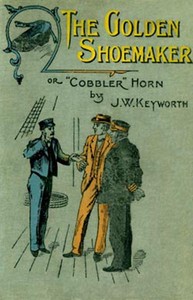
The Golden Shoemaker or 'Cobbler' Horn — Reading Notes
13
2
Project Gutenberg
2007
Inheritance and succession -- Fiction; Christian life -- Fiction; Philanthropists -- Fiction; Missing children -- Fiction
Readers of public-domain and historical texts
Project Gutenberg digital edition
en
Edition facts
Words: 83,492
Reading time: 364 min
Text sections: 9
Source:
Project Gutenberg record #22124
J.W. Keyworth's novel traces a cobbler's transformation after inheritance, his philanthropic schemes, and the search for a lost child. The narrative contrasts humble workshop life with sudden wealth, while weaving in themes of Christian charity and identity through characters like the secretary who was once a 'waif and stray.'
Editorial Edition Score
4.8/5
★★★★★
★★★★★
Calculated from edition completeness, EPUB availability, text structure and catalogue metadata. Not a user rating.
Edition quality
The novel opens with a stark domestic scene: a cobbler's wife dying of consumption in a small house in Cottonborough, her cough audible through the boarded floor. This immediate focus on physical suffering and humble surroundings establishes the work's attention to material detail and class. The protagonist is introduced not by name but by trade—'Cobbler' Horn—a label that persists even after he inherits a fortune. The early chapters juxtapose the cramped workshop with the sudden acquisition of wealth, setting up a central tension between the cobbler's identity and his new role as a philanthropist.
The Workshop as Moral Anchor
The cobbler's bench is not merely a setting but a recurring symbol of humility and honest labor. Even after becoming wealthy, Horn retreats to his old workshop 'for an hour or two on his beloved cobbler's bench.' This detail, drawn from the excerpts, suggests that manual work grounds him amid the complexities of managing money and charitable schemes. The narrative repeatedly returns to the physical space of the workshop—the small house, the kitchen, the boarded ceiling—as a counterpoint to the grander plans for an orphanage. Keyworth uses these domestic interiors to measure Horn's character: his reluctance to abandon his trade signals a resistance to the social mobility that wealth brings. The workshop becomes a moral touchstone, reminding readers that Horn's philanthropy is rooted in his own experience of poverty and loss.
Inheritance and Its Uneasy Transformations
The catalog subjects list 'Inheritance and succession' as a key theme, and the excerpts bear this out. Horn's sudden wealth—he becomes 'golden'—is treated with a mixture of wonder and unease. The chapter titles trace his adjustment: 'The Shoemaker Becomes "Golden"' is followed by 'Free Cobblery' and 'The Golden Shoemaker Waits Upon His Minister.' This sequence implies that money does not automatically confer wisdom or ease. Horn's interactions with lawyers (Messrs. Tongs and Ball) and his secretary reveal a man navigating unfamiliar social terrain. The secretary's revelation that she was once a 'waif and stray' startles Horn, linking his charitable project to his own unresolved grief over his lost daughter, Marian. The inheritance thus functions not as a simple solution but as a catalyst for new complications—financial, emotional, and ethical.
Lost Children and Found Identities
The search for a missing child—likely Horn's daughter Marian—runs through the plot, as indicated by chapters like 'What Had Become of the Child?' and 'A Little Shoe.' The excerpts show Horn's orphanage scheme is explicitly 'for the sake of my little Marian.' Yet the secretary's parallel story—she too was a foundling—creates a mirroring effect. Keyworth uses these parallel lost-and-found narratives to explore questions of identity and belonging. The secretary's cheerful admission, 'I was a waif and stray myself,' contrasts with Horn's solemn grief. The novel seems to suggest that loss can be redeemed through surrogate relationships: the secretary becomes 'like a stream of sunshine' in Horn's life, filling the gap left by Marian. The recurring motif of shoes—the little shoe that triggers recognition—ties back to Horn's trade, making the cobbler's craft a literal and figurative means of reconnection.
Readers should attend to how Keyworth balances sentiment with social observation. The novel's episodic structure—moving from domestic tragedy to philanthropic schemes to detective-like searches—reflects the Victorian fascination with moral improvement and hidden kinship. Pay particular attention to the role of the secretary, whose backstory complicates the simple opposition between rich and poor, found and lost. The cobbler's bench remains a quiet constant amid the plot's upheavals, inviting reflection on what it means to hold onto one's origins while reaching for something higher.
Reader reflection
Your personal reading reflection
Build a private reading journal entry for this title.
Your progress
0
/
10
2
Did this book hold your interest?
3
Is this a title you would suggest to others?
4
Did the language feel accessible?
5
Did the book offer a fresh perspective?
6
Could you see yourself revisiting this book?
7
Did it raise ideas you would like to talk about?
8
Did any part of the book stay with you emotionally?
9
Which lesson or insight stayed with you?
10