1

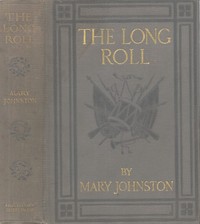
The Long Roll — Context and Discussion
11
1
Project Gutenberg
2007
War stories; United States -- History -- Civil War, 1861-1865 -- Fiction; Jackson, Stonewall, 1824-1863 -- Fiction
Readers of public-domain and historical texts
Project Gutenberg digital edition
en
Edition facts
Words: 267,398
Reading time: 1163 min
Text sections: 27
Source:
Project Gutenberg record #22066
Mary Johnston's 1911 novel follows Stonewall Jackson's Valley Campaign through the eyes of Confederate soldiers, blending historical incidents with fictional characters. The narrative contrasts military precision with personal turmoil, as seen in Stafford's internal war and Ashby's dramatic stand.
Editorial Edition Score
4.9/5
★★★★★
★★★★★
Calculated from edition completeness, EPUB availability, text structure and catalogue metadata. Not a user rating.
Edition quality
Mary Johnston's The Long Roll opens not with a battle but with a town's collective breath held in excitement, a wintry day that sets the stage for a narrative deeply concerned with the psychological weight of war. The novel, the first of two volumes covering the Civil War, draws on documented incidents—as Johnston notes in her preface—to animate its fictional world. From the outset, the prose attends to the sensory: the cold, the sunlight, the strained quiet before action. This is a story that measures its characters not only by their deeds but by their interior distances from the conflict around them.
Stafford's Divided Mind
One of the novel's recurring tensions is the split between public duty and private obsession. In an exchange during the retreat from the Shenandoah, a fellow officer accuses Stafford of being an automaton—executing orders flawlessly yet without soul. Stafford admits to a "big war of his own, in a country of his own," a private conflict that fragments his attention. The dialogue sharpens this contrast: the officer insists that only love or hate can so divide a man, but Stafford wonders if both are illnesses. This interior rift is not merely psychological; it manifests in his actions, as when he walks his horse toward enemy guns with apparent detachment. The novel uses such moments to question whether personal demons can coexist with military effectiveness, leaving the reader to watch for how this split evolves.
Ashby's Mortal Moment
Turner Ashby appears in a vividly rendered scene that captures both his legendary composure and the cost of war. As the bridge burns behind the retreating Confederates, Ashby rides a great black horse, Conrad, while Federal sharpshooters try to bring him down. When a bullet strikes the horse, Ashby dismounts, strokes the animal, kisses it between the eyes, and draws his pistol. The moment is intimate and brutal: the horse is a "poor friend" put down by its master. The scene juxtaposes the grand scale of the campaign—the flaming bridge, the roaring river—with a single, quiet act of mercy. Johnston's prose here is precise, avoiding sentimentality while underscoring the personal losses that accumulate alongside tactical gains. The episode stands as a counterpoint to Stafford's detachment, showing a leader fully present in a moment of grief.
The Landscape of War
The natural world in The Long Roll is never merely a backdrop. The Shenandoah River, swollen and angry, becomes a tactical obstacle that delays Frémont's pursuit. The wind in the pines recurs as a motif, heard by Stafford during a conversation about the campaign's resemblance to Napoleon's Italian campaign. The novel's setting is saturated with weather and terrain that shape military outcomes: the "inky, tempestuous sky," the flaming bridge that lights the night, the green fields south of Harrisonburg where horses graze. Johnston's attention to these details roots the story in a specific geography, one that soldiers must read and respond to. The landscape is both a resource and an adversary, and the narrative's pacing often mirrors the movement of armies through it—swift, then stalled, then surging again.
Readers approaching The Long Roll should attend to the spaces between battles: the conversations, the silences, the moments when characters step aside from the march. Johnston's method is to embed personal conflict within historical event, and the novel rewards those who watch for the small gestures—a kiss on a horse's forehead, a half-heard remark about an automatic chess-player—that reveal the war's inner toll. The book's length (over 267,000 words) allows for such accumulation, and its episodic structure invites patient reading.
Reader reflection
What did you think of this book?
Answer a few questions and save a private reflection on this device.
Your progress
0
/
10
2
Did this book hold your interest?
3
How likely are you to recommend this book?
4
How much effort did this book require?
5
Could you apply anything you learned?
6
Did the book offer a fresh perspective?
7
Did you relate to its people, ideas, or situations?
8
Was the book what you thought it would be?
9
Which lesson or insight stayed with you?
10