1

Aunt Jane of Kentucky — Themes and Context
12
1
Project Gutenberg
2008
Domestic fiction; Widows -- Fiction; Older women -- Fiction; Kentucky -- Fiction
Readers of public-domain and historical texts
Project Gutenberg digital edition
en
Edition facts
Words: 66,225
Reading time: 288 min
Text sections: 7
Source:
Project Gutenberg record #26728
Eliza Calvert Hall's 1907 collection of linked stories centers on elderly Aunt Jane, whose reminiscences of rural Kentucky life unfold through domestic objects, seasonal shifts, and the rhythms of speech. The narrative moves between her parlor and the remembered landscapes of courtship, church, and community, using a frame narrator who draws out details of the past.
Editorial Edition Score
4.7/5
★★★★★
★★★★★
Calculated from edition completeness, EPUB availability, text structure and catalogue metadata. Not a user rating.
Edition quality
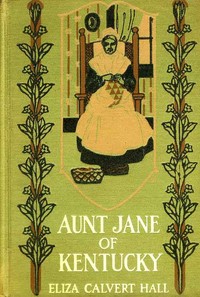
The first chapter of Aunt Jane of Kentucky opens not with a plot but with a room: a rag carpet, Shaker rockers, a mahogany table, and Aunt Jane herself in purple calico and a substantial lace cap. The narrator, a visitor, is invited to sit by the window where June breezes carry clover scent from across the road. This careful inventory of objects—the “hit-or-miss” pattern, the tidy of snowy thread—anchors the reader in a specific domestic world. Hall uses the frame narrator not merely to record Aunt Jane’s stories but to prompt them, asking questions that draw out memories of church membership, courtship, and the baptism at Kittle Creek. The result is a layered narrative where the present room and the remembered past coexist, each illuminating the other.
The Frame as a Lens on Memory
The book’s structure depends on a frame narrator who visits Aunt Jane and listens to her tales. This device is not a passive container; the narrator actively shapes the memories by asking pointed questions and even supplying sensory details—the purple haze on hills, the brown leaves in fence corners—that Aunt Jane confirms with surprise. In the excerpt, the narrator’s guess about violets and wood ferns prompts Aunt Jane to exclaim, “Are you a fortune-teller?” The exchange reveals how memory is co-constructed: the visitor’s imagination fills gaps, and Aunt Jane’s recollections become more vivid through collaboration. This interplay between listener and teller recurs throughout the chapters, making the act of remembering itself a subject of the book.
Recurring Images: Clover, Thunder, and Domestic Objects
Hall weaves a handful of sensory images across the opening pages. Clover and bluegrass “running sweet riot” in June establish a Kentucky landscape that is both lush and specific. Later, the August afternoon brings “gathering thunder-clouds” and a low rumble, prompting Aunt Jane to worry about young turkeys. These weather details do more than set a scene; they mark the passage of time within a single visit and connect the present to past seasons. Domestic objects also recur: the rag carpet, the shuck-bottom chairs, the apron pocket holding knitting. Each item is described with precision—the “substantial structure” of Aunt Jane’s cap, the “lock of gray hair” in her pin—creating a tactile world that feels both dated and lovingly preserved. The narrator’s observation that the room “carried me back to a dead and gone generation” signals that these objects are not mere decoration but vessels of memory.
Movement Between Scenes: The Parlor and the Past
The narrative shifts fluidly between Aunt Jane’s parlor and the remembered landscapes of her youth. In the excerpt, a discussion of church membership leads to a flashback of sitting “under the bank on a rock” with her husband Abram, sheltered from the north wind. The transition is seamless: Aunt Jane’s speech, with its characteristic “as I was sayin’,” carries the reader from present to past and back again. Hall does not mark these shifts with chapter breaks or typographical cues; instead, the movement is governed by association. A question about Marthy’s son prompts a story about baptism; a remark about joining churches leads to a memory of Alexander Campbell baptizing Aunt Jane’s parents in Drake’s Creek. This associative structure mirrors the way memory actually works, and it gives the book a rhythm that feels natural rather than plotted.
Voice and Dialect as Structural Elements
Aunt Jane’s speech is rendered in a careful dialect that includes dropped g’s (“wishin’,” “set down”), archaic constructions (“I reckon,” “La, yes”), and a distinctive rhythm of repetition and qualification. Her sentences often loop back on themselves: “But as I was sayin’, me and Abram had the church question to settle after we was married, and I don’t believe either one of us thought about it till Sunday morni[ng].” This oral quality is not just local color; it structures the narrative by creating a sense of spontaneous storytelling. The narrator’s own voice is more formal, but it never overwhelms Aunt Jane’s. The contrast between the two registers—the visitor’s literary language and Aunt Jane’s vernacular—reinforces the distance between generations and the act of translation that memory requires. Hall uses this vocal texture to make the past feel immediate, even as the frame reminds us that it is being recalled.
Readers will find that the book rewards attention to its small details: the way a thundercloud or a patch of clover can trigger a story, the precise naming of furniture and fabric, the pauses and digressions in Aunt Jane’s talk. The chapters are best taken one at a time, allowing each reminiscence to settle before moving to the next. The frame narrator’s role is worth watching—she is not a neutral recorder but an active participant whose questions shape what we learn. And the recurring images of weather, landscape, and domestic life form a quiet pattern that ties the separate stories together.
Reader reflection
What did you think of this book?
Answer a few questions and save a private reflection on this device.
Your progress
0
/
10
2
How did the book work for you overall?
3
Would you encourage someone else to read it?
4
How much effort did this book require?
5
Did the book give you something worth debating?
6
Which aspect of the book did you value most?
7
How distinctive were its ideas or approach?
8
Was the book what you thought it would be?
9
What is the main idea you are taking away?
10