1

Condemned as a Nihilist: A Story of Escape from Siberia — Reading Notes
13
2
Project Gutenberg
2008
Escapes -- Fiction; Russia -- History -- Alexander II, 1855-1881 -- Fiction; Siberia (Russia) -- Fiction
Readers of public-domain and historical texts
Project Gutenberg digital edition
en
Edition facts
Words: 133,319
Reading time: 580 min
Text sections: 12
Source:
Project Gutenberg record #26090
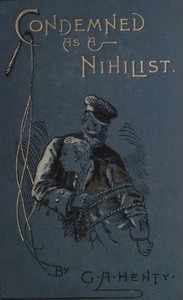
G. A. Henty's novel follows Englishman Godfrey Bullen, wrongly condemned as a nihilist and sent to Siberian mines. The text reveals Henty's characteristic direct dialogue, precise bribe amounts, and careful escape logistics, offering a specific, evidence-based look at authorial choices in diction and description.
Editorial Edition Score
4.9/5
★★★★★
★★★★★
Calculated from edition completeness, EPUB availability, text structure and catalogue metadata. Not a user rating.
Edition quality
From the opening pages, Henty establishes a brisk, declarative style that prioritizes action over introspection. The narrative voice is economical, often letting dialogue carry exposition. When Godfrey Bullen offers a hundred roubles to the convict Mikail, the exchange is rendered in short, unadorned sentences: “I will not take it,” the man said huskily; “it is a hundred roubles.” The emotional weight is carried by the characters' words and the precise sum of money, not by authorial commentary. Henty's prose is notably concrete, specifying amounts like “five roubles” for a Cossack's bribe and “five hundred still left” in Godfrey's funds. This attention to financial detail grounds the story in a tangible world of trade-offs and risks.
Dialogue as a Vehicle for Character and Plot
Henty uses dialogue not merely to advance the plot but to reveal character and social dynamics in a compressed manner. When Godfrey reveals his true name—“I am English, and it is to England I shall make my way”—the confession is embedded in a practical conversation about money and future correspondence. The exchange with Mikail Stomoff is layered: Godfrey insists on giving the roubles, Mikail resists, and the negotiation ends with a promise to pray before the ikon. Henty avoids internal monologue; instead, the reader infers Godfrey's generosity and Mikail's gratitude from their spoken words and the stage directions (“the man said huskily,” “with tears in his eyes”). The dialogue also serves as a mnemonic device, as Mikail repeats Godfrey's name “four or five times over,” underscoring the importance of memory in a world of surveillance and separation.
The Role of Money and Bribery in the Narrative
Throughout the excerpt, money functions as a concrete measure of risk and relationship. Henty specifies exact sums: a hundred roubles given to Mikail, five hundred retained by Godfrey, and five roubles offered to a Cossack guard. These figures are not arbitrary; they reflect the economic realities of the Siberian penal system, where guards' pay was meager and bribes were a routine currency of survival. The Cossack's willingness to accept “five roubles” for allowing Godfrey to drop behind is presented without moral judgment—it is simply a transaction. Henty's diction here is clinical: “Five roubles was a large sum to the soldier.” The author does not sentimentalize the bribe; he treats it as a logical element of the escape plan. This precision gives the story a documentary texture, grounding the adventure in verisimilitude.
Spatial and Temporal Specificity in Escape Planning
Henty's description of Godfrey's preparations for escape is marked by careful spatial and temporal markers. Godfrey “observed very carefully the spot where he had hidden the tools” and marks it by “piling three small stones one on the top of the other by the roadside.” The detail is exact: three stones, not two or four. The timeline is equally precise: the journey is “too long to do in one summer,” and Godfrey expects to reach England “by the following autumn.” He promises to write “before the Christmas after next,” and if that fails, “a year later.” These specifics create a framework of realistic constraints. Henty does not rely on vague phrases like “sometime later”; he anchors the escape in a calendar of seasons and holidays, reinforcing the impression that the narrative is built on researched or plausible logistics.
The Function of Minor Characters as Moral Anchors
Minor characters in the excerpt serve as ethical counterpoints to the harsh penal environment. Mikail Stomoff, the starosta (prison elder), and his wife Feodora are defined by their piety and loyalty. Mikail's refusal to accept the money—“I would not rob you”—and his promise to pray “before the ikon” establish a moral framework that contrasts with the Cossack's mercenary willingness to take a bribe. Osip, another convict, declines to join the escape because he has “lost two years already by running away.” His caution provides a foil to Godfrey's daring. Henty uses these figures to populate the world with varied responses to oppression, from resistance to accommodation. Their dialogue is functional: they exist to advance Godfrey's plan and to reflect the spectrum of convict experience, but Henty gives them distinct voices and motivations within the constraints of his brisk style.
Readers attentive to Henty's craft will notice how he balances adventure with a reporter's eye for detail. The novel rewards those who track the financial transactions, the named locations (Karoff, near Kara), and the recurring motif of letters as lifelines. Henty's authorial choices—his reliance on dialogue, his specificity about sums and distances, and his use of minor characters as moral touchstones—create a narrative that is both swift and grounded. This edition invites scrutiny of how a popular Victorian author constructed a tale of wrongful conviction and escape without resorting to psychological depth, relying instead on the concrete and the spoken.
Reader reflection
How did this book work for you?
Your answers remain private and are stored only in this browser.
Your progress
0
/
10
2
How did the book work for you overall?
3
Would you encourage someone else to read it?
4
What was the reading difficulty like?
5
How strongly did the book affect you emotionally?
6
Could you see yourself revisiting this book?
7
How strong was your personal connection to the text?
8
Could you apply anything you learned?
9
What changed or sharpened your thinking?
10