1

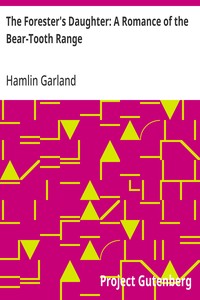
The Forester's Daughter: A Romance of the Bear-Tooth Range — Story, Setting & Ideas
13
3
Project Gutenberg
2008
Western stories; Young women -- Fiction; Colorado -- Fiction
Readers of public-domain and historical texts
Project Gutenberg digital edition
en
Edition facts
Words: 68,740
Reading time: 299 min
Text sections: 8
Source:
Project Gutenberg record #26239
Hamlin Garland's 1914 romance follows Berea McFarlane, a rancher's daughter, and Wayland Norcross, an Easterner, in the Colorado Rockies. The narrative shifts between Berrie's forceful domesticity and Wayland's self-conscious weakness, with vivid descriptions of forest, storm, and cabin life.
Editorial Edition Score
4.7/5
★★★★★
★★★★★
Calculated from edition completeness, EPUB availability, text structure and catalogue metadata. Not a user rating.
Edition quality
From its opening pages, The Forester's Daughter announces a narrative voice that oscillates between the idyllic and the pragmatic. The author's foreword confesses that the character of Berea McFarlane 'took the story into her own strong hands,' and the prose bears this out: Berrie's dialogue is direct and commanding—'Well, how do you stack up this morning?'—while Wayland Norcross's interior monologues are hesitant and self-deprecating. The novel's pace mirrors this tension, alternating between leisurely descriptions of mountain scenery and sudden, urgent action, such as a ride in the rain or a death-grapple. Garland's language is rooted in sensory detail—the roar of a stove, the sizzle of bacon, the 'deep blackness of the night'—but also reaches for epic resonance, likening Berrie to 'the typical frontier wife, the goddess of the skillet and the coffee-pot.'
Berrie's Voice and Wayland's Hesitation
The excerpts reveal a stark contrast in narrative voice between the two main characters. Berea McFarlane speaks in short, forceful sentences: 'Don't try it now. Wait till you have had your breakfast.' Her actions are described with a sense of scale—'through the haze of the kitchen smoke she enlarged till she became the typical frontier wife.' Wayland, by contrast, is given to self-critical reflection: 'Of course, it is not my fault that I am a weakling,' he argues internally. His voice is tentative, full of qualifiers like 'perhaps' and 'if I come safely out of this adventure.' This dichotomy drives the romance: Berrie's decisiveness pulls Wayland along, while his introspection slows the narrative. The novel's dialogue often pits her bluntness against his politeness, as when he offers to be 'an excellent white liar' to deflect a tourist's questions.
Pace and the Shifting Scene
Garland manipulates pace through setting and action. Early chapters like 'A Ride in the Rain' and 'Storm-Bound' compress time into intense, claustrophobic episodes—Wayland's illness, the cabin vigil—where paragraphs are short and sensory: 'the stove roar and the bacon sizzle.' In contrast, passages of travel or description, such as 'The Golden Pathway,' expand time with longer, more lyrical sentences. The chapter titles themselves signal these shifts: 'The Death-Grapple' promises violence, while 'A Matter of Millinery' suggests comic relief. The excerpts show a pattern: after a crisis (Wayland's collapse, the arrival of tourists), the prose relaxes into observation of the 'wooded hills' or 'the beat of hoofs upon the bridge.' This rhythm of tension and release keeps the reader attuned to the characters' emotional states.
Recurring Details of Domesticity and Danger
Certain concrete details recur, linking the domestic and the wild. The cabin is a central space: its stove, skillet, and coffee-pot appear repeatedly, grounding the romance in daily labor. Yet the same cabin is vulnerable to intrusion—by tourists, by gossip, by the Supervisor's arrival. Wayland's illness is described with clinical precision: 'every muscle in his body seemed to cry out against being moved,' while Berrie's ministrations are equally physical—'she brought his breakfast to him, and sat beside him while he ate.' The natural world mirrors this duality: the 'roaring stream' and 'somber majesty' of hills contrast with the 'prying camp-robbers' (birds) mentioned in the foreword. Even the title's 'Bear-Tooth Range' suggests both a specific geography and a latent threat. These repeated elements create a cohesive world where comfort and peril coexist.
Readers attentive to Garland's craft will notice how the author's own voice intrudes in the foreword—claiming Berrie as a fiction 'born of a momentary, powerful hand-clasp'—and then recedes as the narrative proceeds. The novel's interest lies less in plot twists than in the gradual convergence of two distinct speech patterns and worldviews. Pay attention to moments when Wayland's internal commentary slows the action, and when Berrie's directness accelerates it; these shifts are the engine of the romance.
Reader reflection
How did this book work for you?
Your answers remain private and are stored only in this browser.
Your progress
0
/
10
2
What was your overall reaction to the book?
3
Would you recommend this book to another reader?
4
How easy was the book to follow?
5
How distinctive were its ideas or approach?
6
Could you apply anything you learned?
7
How closely did the book connect with your experience?
8
Which aspect of the book did you value most?
9
In one sentence, what did you learn?
10