1

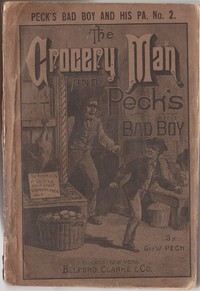
The Grocery Man And Peck's Bad Boy Peck's Bad Boy and His Pa, No. 2 - 1883 — Reading Companion
12
2
Project Gutenberg
2008
American wit and humor; Boys -- Fiction; Practical jokes -- Fiction
Readers of public-domain and historical texts
Project Gutenberg digital edition
en
Edition facts
Words: 50,834
Reading time: 222 min
Text sections: 6
Source:
Project Gutenberg record #25488
In this sequel, Peck's Bad Boy recounts his schemes involving a grocery man, his long-suffering Pa, and a baby sister, with the boy's narration revealing a sharp eye for adult hypocrisy and a talent for turning everyday situations into comic disasters.
Editorial Edition Score
4.7/5
★★★★★
★★★★★
Calculated from edition completeness, EPUB availability, text structure and catalogue metadata. Not a user rating.
Edition quality
Peck's Bad Boy narrates his own adventures in a voice that mixes bravado with a keen sense of how to manipulate the adults around him. In the excerpts, he describes quitting his job as a soda jerk because the work felt fraudulent—"worse than three card monte"—and taking up a position as a "super" at the theater, a role that involves carrying chairs and lacing corsets. His Pa, who "may seem pious," is eager to go behind the scenes to see ballet girls. The catalog subjects label the book as "American wit and humor" and "practical jokes," but the excerpts show a more layered comedy: the boy's observations about his parents' double standards are as sharp as the pranks themselves.
The Narrator's Voice and Self-Awareness
The bad boy does not simply recount pranks; he reflects on his own motives and the reactions of others. When explaining why he quit the soda fountain, he says, "He feels that he is a fraud," and compares the business to gambling. This self-awareness extends to his family: he notes that his Ma initially opposes the theater as "the hotbed of sin," but changes her mind when promised free tickets and face-powder recipes. The boy's narration thus becomes a vehicle for social commentary, exposing how quickly moral objections dissolve when personal benefit appears.
The Grocery Man as Foil and Straight Man
The grocery man appears in the excerpts as a skeptical adult who tries to outsmart the boy but is repeatedly outmaneuvered. He moves a box of raisins "out of reach" and warns that "a rolling hen never catches the early angleworm." Yet the boy dismisses his advice with a flurry of explanations about his new theater job. The grocery man's role is not merely that of a victim; he represents the practical, worldly adult world that the boy both exploits and mocks. Their exchanges highlight the generational and moral tensions that drive the humor.
Domestic Dynamics and Hypocrisy
The excerpts reveal a household where the boy's parents are complicit in his schemes when it suits them. His Pa, despite outward piety, "likes to look at ballet girls better than any meek and lowly follower I ever see," and uses the boy's theater job as an excuse to go backstage. His Ma, initially horrified by the stage, quickly warms to the idea of free tickets and beauty secrets. The boy's narration exposes these contradictions without moralizing, letting the reader laugh at the parents' self-deception. The baby sister, referred to as "Old Number Two," is another target of the boy's irreverence, but the excerpts suggest that even the most sacred family roles are not safe from his satirical eye.
Readers should pay attention to the way the bad boy frames his own actions: he is not a simple troublemaker but a shrewd observer who knows exactly how to present his exploits to maximize comic effect. The humor depends on the gap between what he says and what the reader infers about the adults' gullibility. This edition preserves the original illustrations and chapter headings, which add another layer of period detail to the boy's world.
Reader reflection
What did you think of this book?
Answer a few questions and save a private reflection on this device.
Your progress
0
/
10
2
How much did you enjoy the reading experience?
3
Would you recommend this book to another reader?
4
Did the language feel accessible?
5
How would you describe its reading pace?
6
Could you apply anything you learned?
7
Did any part of the book feel personally relevant?
8
Would a second reading be valuable?
9
What is the main idea you are taking away?
10