1

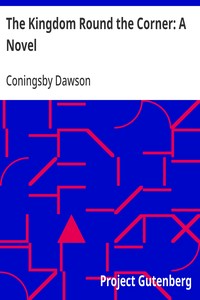
The Kingdom Round the Corner: A Novel — A Closer Reading
7
1
Project Gutenberg
2008
Man-woman relationships -- Fiction; England -- Social life and customs -- 20th century -- Fiction; World War, 1914-1918 -- Veterans -- Fiction
Readers of public-domain and historical texts
Project Gutenberg digital edition
en
Edition facts
Words: 97,136
Reading time: 423 min
Text sections: 9
Source:
Project Gutenberg record #25702
Dawson's 1921 novel follows Tabs, a WWI veteran returning to a changed England in 1919. The opening contrasts his war-zone heroism with post-war disorientation, while later passages reveal his bitter meditation on women's emasculating power—except for the idealized Terry. The narrative voice shifts from dazed observation to misogynistic rant, offering a fractured portrait of a man struggling to reconcile past and present.
Editorial Edition Score
4.8/5
★★★★★
★★★★★
Calculated from edition completeness, EPUB availability, text structure and catalogue metadata. Not a user rating.
Edition quality
The novel begins on a blustering March morning in 1919, with Tabs—a veteran recently discharged after five months of bullet extractions—stepping into a world that has not waited for him. Dawson establishes his protagonist's disorientation through a precise physical detail: Tabs walks with a limp that is 'not too perceptible unless he grew tired.' The prose immediately signals a psychological fracture: Tabs feels 'dazed, vaguely happy and a little lost,' as if released from prison. His realization that he has only four years until forty, delivered by a character named Terry, sharpens the temporal anxiety that will drive the narrative.
The Altered World of 1919
The first chapter, titled 'An Altered World,' sets the novel's temporal and emotional coordinates. Tabs's return is not a homecoming but an encounter with a foreign country: the world has 'marched impolitely forward' during his absence. Dawson uses the March weather—blustering, unsettled—to mirror Tabs's internal state. The prose is deliberately flat in these opening paragraphs, avoiding the romanticism of a soldier's return. Instead, Tabs's limp becomes a metonym for his halting re-entry into civilian life. The mention of Terry, who reminds him of his age, introduces a relationship that will anchor his sense of loss. Readers should note how the narrative withholds any description of Tabs's war experience; the focus is entirely on the aftermath, on what it feels like to be a man out of step with time.
A Voice of Bitter Meditation
Later in the excerpts, the narrative voice shifts dramatically into a sustained, misogynistic meditation on women as Delilahs who strip men of their strength. This passage, likely from a middle chapter, generalizes from Tabs's personal grievances to a universal indictment: women's 'little teasing hands' have 'commenced the débâcle of every human greatness.' The prose becomes rhetorical, even biblical, invoking Samson and the Philistines. Dawson contrasts this with the war dead—Pollock, Lord Dawn, Braithwaite—who are remembered as noble precisely because they were 'womanless.' The passage is striking for its intensity and its lack of irony; it presents Tabs's thoughts without narrative distance. Readers should consider whether this voice represents Tabs's genuine conviction or a defensive posture, and how it might complicate sympathy for the protagonist.
Exceptions and Idealization
Amid the diatribe, Tabs makes two exceptions: Terry, whom he imagines as a 'Joan of Arc' inspiring heroism, and Lady Dawn—or rather, her portrait. The distinction is telling: he exempts the painted Lady Dawn, not the living woman who 'mocked him in passing with her steady stone-gray eyes.' This split between idealized image and disappointing reality recurs throughout the excerpts. Terry remains a figure of purity, untouched by the general condemnation. The narrative does not provide enough evidence to determine whether Terry is a fully realized character or a projection. What is clear is that Tabs's mental landscape is divided between a debased present (women as binders) and a purified past (the war, the dead, the imagined Terry). This binary structure may govern the novel's plot, as Tabs searches for a 'kingdom round the corner' that reconciles these poles.
Structure and the Reader's Path
The table of contents reveals a symmetrical architecture: eight chapters, the first titled 'An Altered World' and the last 'Round the Corner.' The middle chapters—'Retrievers of Youth,' 'All Sorts of Kingdoms,' 'The Complications of Maisie'—suggest a progression from disorientation to quest to entanglement. The excerpts do not reveal how Tabs's relationship with Terry or Braithwaite (mentioned as both a war hero and a rival) develops. The reader must navigate between the opening's dazed realism and the later passage's rhetorical fury, deciding whether the novel endorses Tabs's worldview or critiques it. Dawson's prose is capable of both precise observation and sweeping generalization; the tension between these modes is the novel's central formal feature. Pay attention to how the illustrations by W.D. Stevens (only one caption is given: Tabs apologizing) might frame key scenes.
As you read, track how Dawson modulates between Tabs's external actions and his interior monologues. The excerpts suggest a protagonist who is both observer and obsessive, capable of tenderness and venom. The novel's title promises a discovery—a kingdom just out of sight—but the evidence leaves open whether that kingdom is a place, a person, or a state of mind. Let the inconsistencies in Tabs's voice guide your interpretation: what he exempts may be as revealing as what he condemns.
Reader reflection
How will you remember this book?
Save your reaction, strongest insight, and memorable passage.
Your progress
0
/
10
2
What was your overall reaction to the book?
3
Would you recommend this book to another reader?
4
How easy was the book to follow?
5
Did the story or argument move comfortably?
6
How strongly did the book affect you emotionally?
7
Was the book what you thought it would be?
8
Would you like to discuss this book with someone?
9
What did this book teach you most?
10